Report by Kevin McCaffree & Anondah Saide
Executive Overview
- Around 1 in 3 younger adults (GenZ and Millennials) expressed support for political violence.
- Support for political violence was highest among those identifying as politically “very liberal.”
- Liberal GenZ women were more supportive of political violence than were GenX and Baby Boomer men.
- Americans with the highest level of educational attainment (graduate or professional degree) were about twice as likely to support political violence than those with less formal education.
- Over half of Black GenZ adults agreed that “Violence is often necessary to create social change.”
McCaffree, K., & Saide, A. (2025). Support for Political Violence Among Americans. Skeptic Research Center. Retrieved from https://research.skeptic.com/support-for-political-violence-among-americans/
Background
For years academics have predicted that America is set to enter a period of increased political violence;1 with the recent assassinations of Charlie Kirk and Melissa Hortman, as well as several assassination attempts against Donald Trump, such predictions seem prescient. Yet, because analysts and commentators cannot come to an agreement over what counts as political violence—there may be as many as 100 different scholarly and diplomatic definitions of “terrorism” for example2—it has so far been unclear the extent to which such violence is increasing on the political left and right, and although it seems more prevalent on the political left at the moment, without such clear definitions and datasets tracking such trends for decades, there’s no way for social scientists to know for sure.
Nevertheless, there are reasons to suspect that instances of left-wing political violence are under counted. For example, mainstream organizations that track incidents of political violence, like the American Civil Liberties Union (ACLU) and Southern Poverty Law Center (SPLC), routinely suggest that political conservatives commit far more acts of political violence than do liberals. However, many have pointed out that these very organizations also routinely overlook left-wing political violence, for example, the two billion dollars of property damage,3 two dozen people killed,4 and establishment of illegal “autonomous zones”5 during the Black Lives Matter and George Floyd Riots of Summer 2020. In fact, in this particular case, the ACLU and SPLC ran glowing articles with titles like “The Power of Protest: Remembering the Legacy of George Floyd.”6
So, absent reliable data untainted by political bias, the exact nature of trends of political violence is unclear. Of course, we cannot assess acts of political violence in a survey, only the degree to which people express agreement or disagreement with such acts. But support for political violence, tacit or otherwise, may accelerate its prevalence and is therefore worth better understanding. Is it conservatives, as academic databases would have us believe? Or is it liberals, the group virtually never identified as violent in any academic databases?7, 8 Are middle-aged Americans more supportive of political violence than younger Americans? Are men more supportive than women? What about education—are less educated Americans more supportive of political violence than highly educated Americans, or is it the reverse? We set out to answer these questions in the Fall of 2025.
Methodology and Data Quality
Generation Z (18–28 years old)
Millennials [Gen Y] (29–44 years old)
Generation X (45–60 years old)
Baby Boomers (61–80 years old)
The data from this report come from the American Political Perspectives Survey (APPS) collected from August 3, 2025, to September 26, 2025, with three thousand American adults who speak English. All respondents needed to pass (1) four attention checks, (2) a duplication check, (3) time-to-completion checks (i.e., those taking the survey in under 7 minutes were dropped), (4) fraud checks, and (5) bot-identification checks.
Quota sampling was used to approximate a representative sample of the U.S. public regarding sex, race, age, and educational attainment. Quotas were determined using U.S. Census data. Additional attempts were made to oversample Asians. Respondents were recruited using Qualtrics Panel Services.
Further details on the respondents can be downloaded.
To measure support for political violence, respondents were asked to what extent they agree or disagree with the following two statements (using a 6-point Likert scale ranging from Strongly Disagree to Strongly Agree): (1) “Violence is often necessary to create social change” and (2) “If you are protesting something unjust, it is reasonable to damage property.”
Summary of Findings
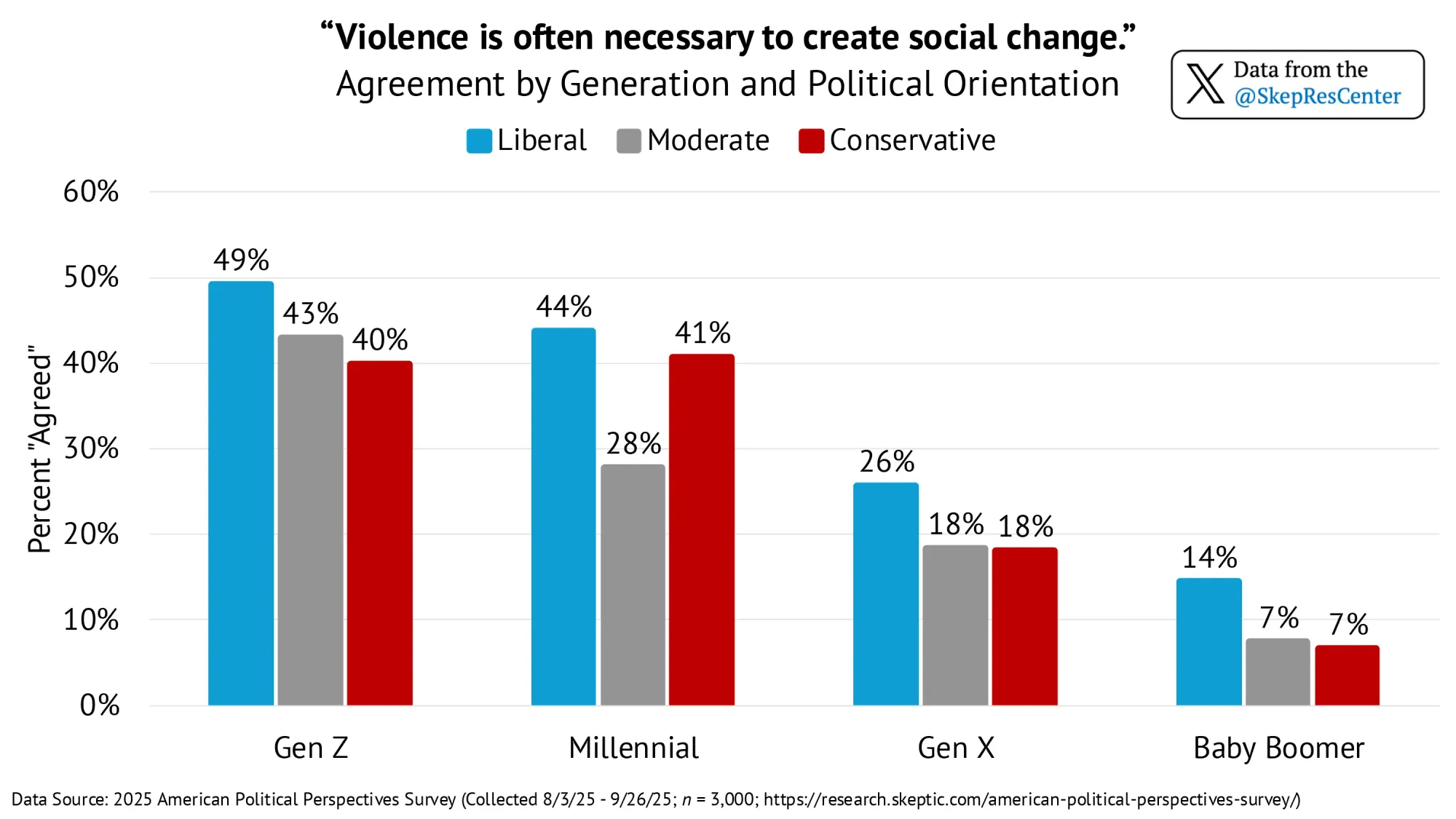
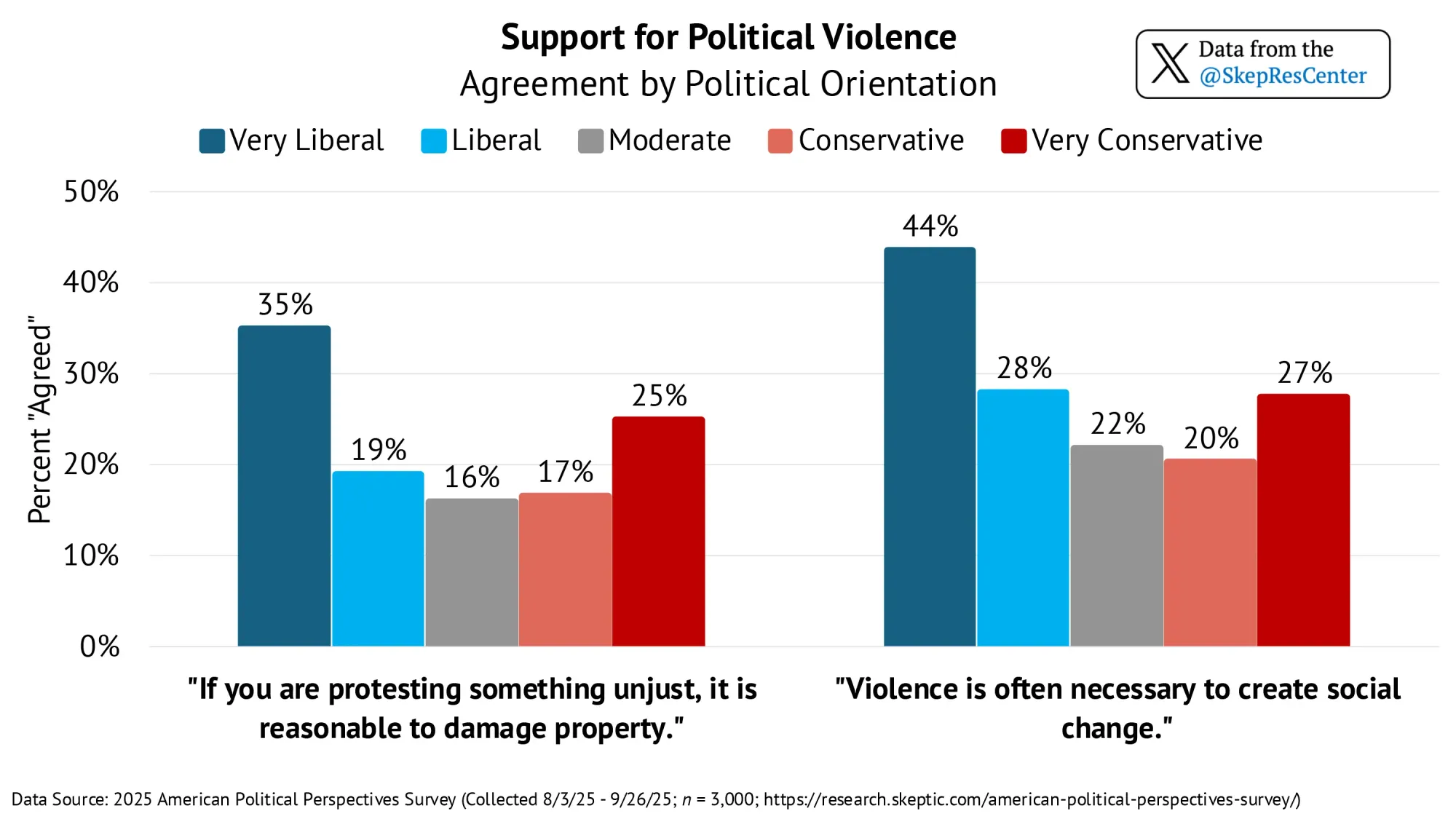
A number of interesting patterns emerged from the data. First, nearly half (49 percent) of GenZ political liberals in the sample agreed with the statement, “Violence is often necessary to create social change” (see Figure 1 below). Generally, younger Americans, and those identifying politically as “very liberal” (see Figure 2 below), were more likely to agree with this than were older Americans and those of other political orientations. Younger adults and those identifying as “very liberal” were also more likely to agree, “If you are protesting something unjust, it is reasonable to damage property.”
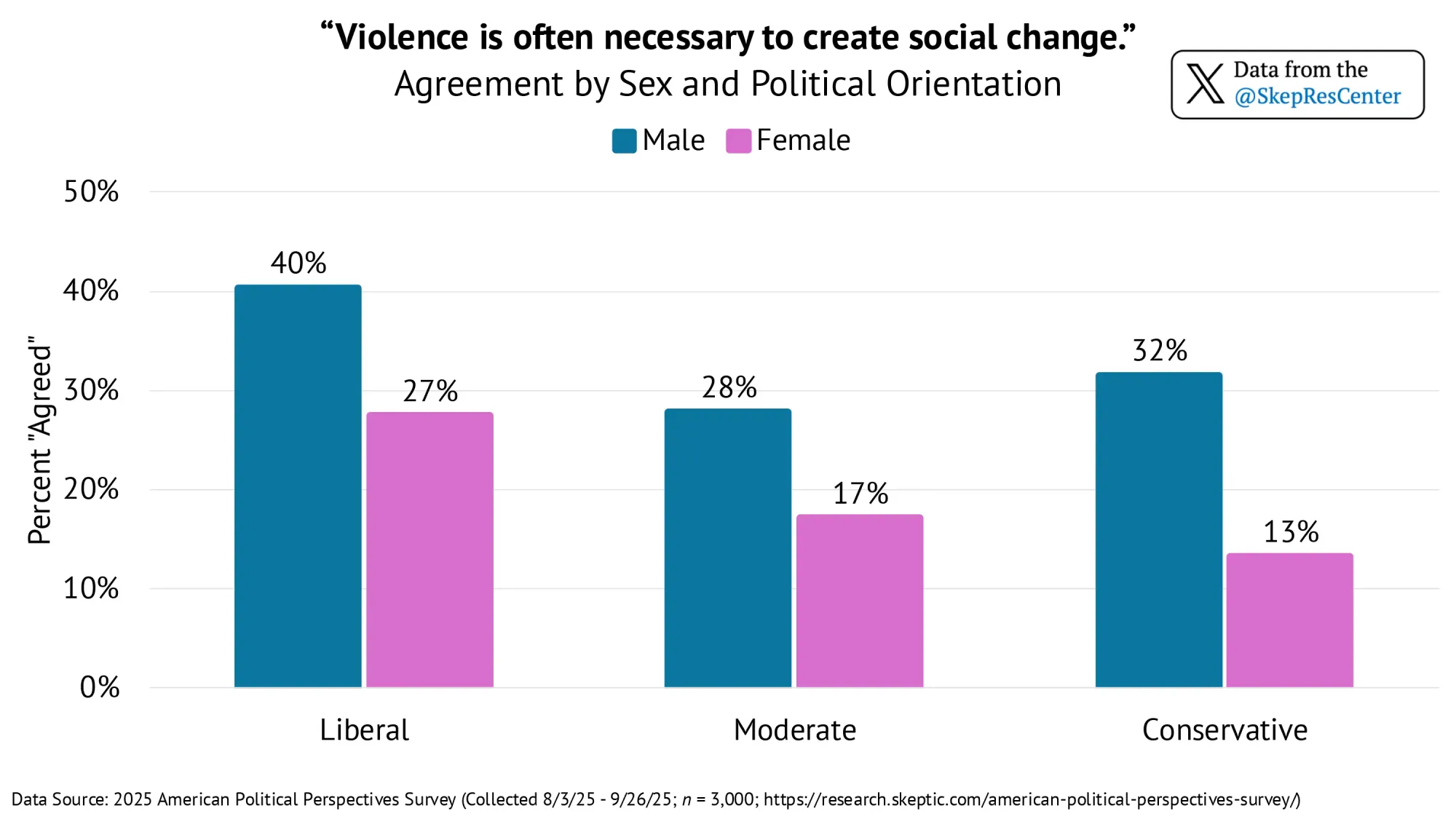
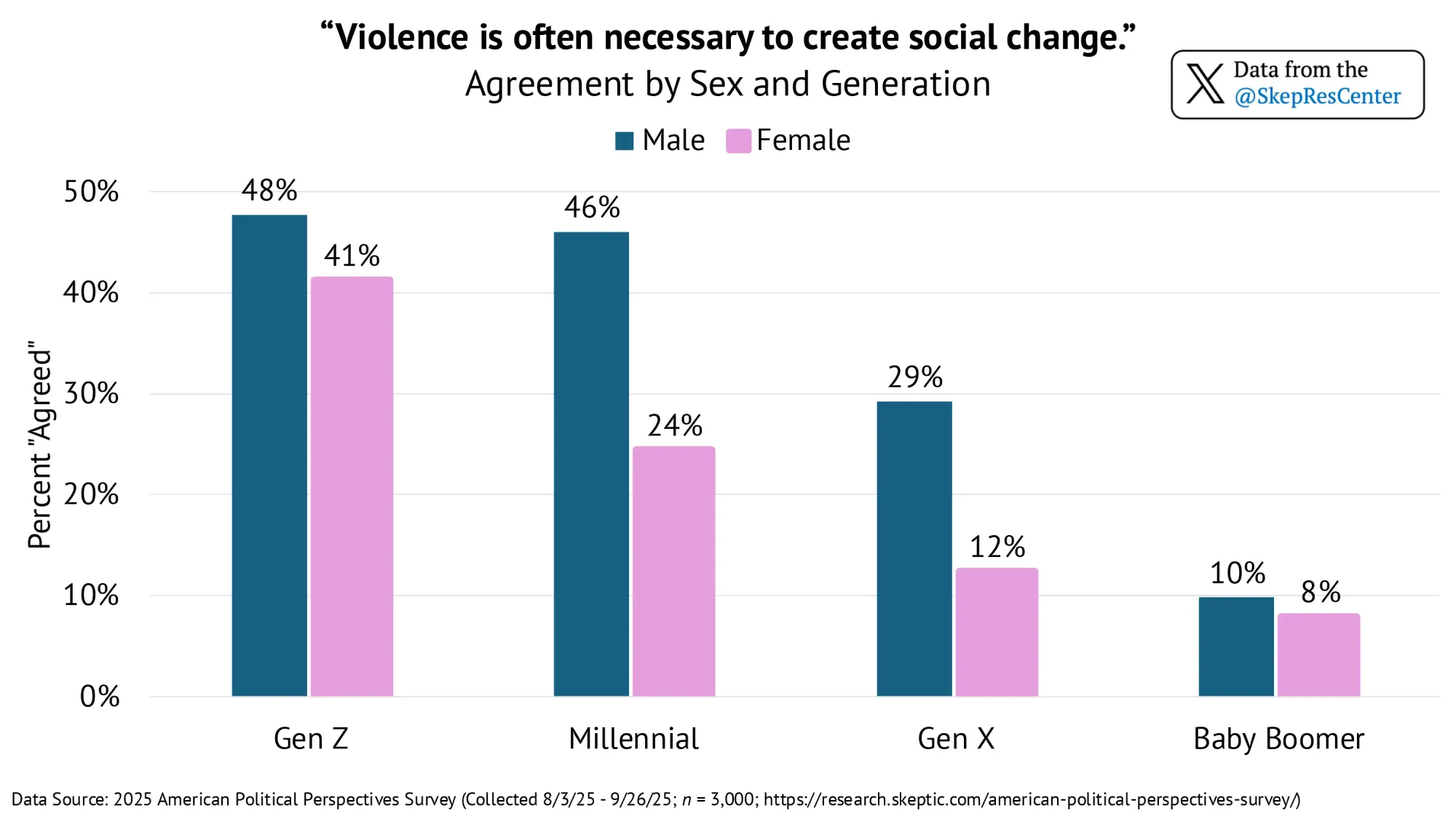
Next, when looking at men and women, we found that overall, men were unsurprisingly more supportive of political violence than women (since men account for violence of all kinds far more than do women). Politically liberal men were the most likely to agree with the statement, “Violence is often necessary to create social change” (see Figure 3 below). Notably however, politically liberal women were about as likely to agree with this as were politically moderate men, and politically liberal GenZ women were more supportive of political violence than were GenX and Baby Boomer men (see Figure 4 below).
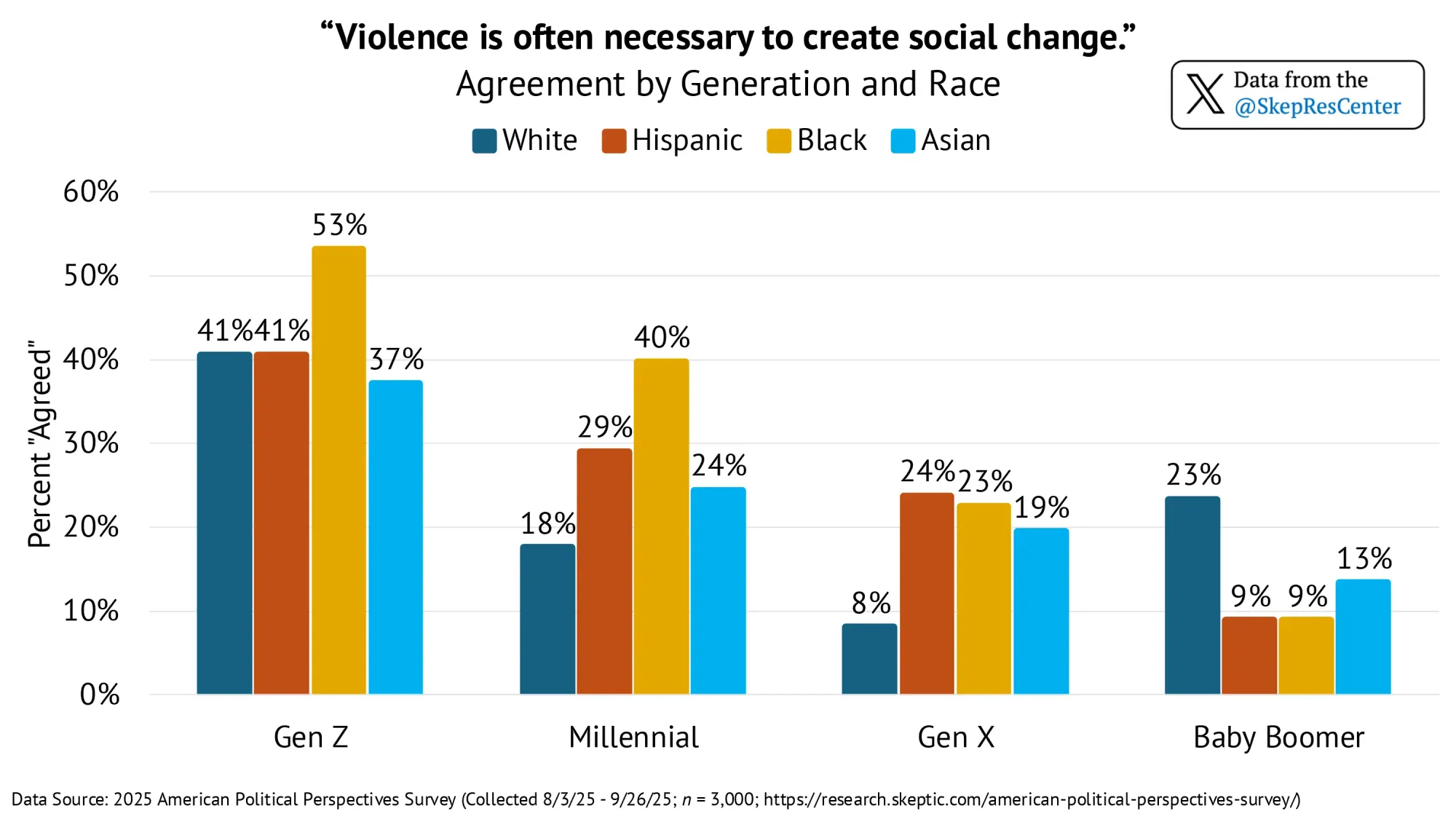
With regard to race, over half (53 percent) of black GenZ Americans agreed with the statement, “Violence is often necessary to create social change” (see Figure 5 below). No other racial group in our survey was more supportive of political violence than black GenZ respondents. Among GenX, whites were the least supportive of political violence, but among Baby Boomers, whites were the most supportive of political violence. In general, Asians were the least likely to agree, “Violence is often necessary to create social change.”
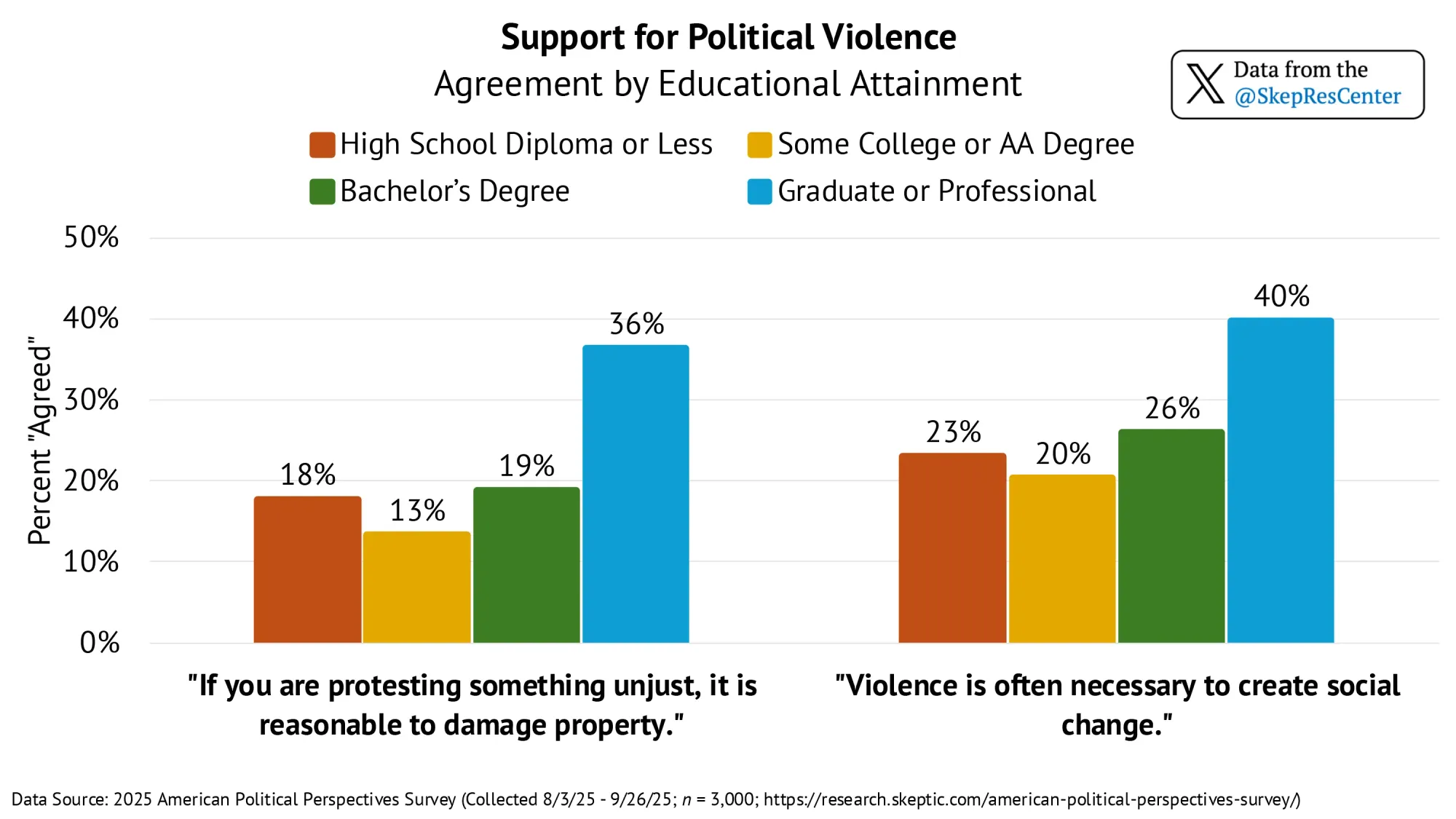
Finally, we found that Americans with the highest level of formal education were also the most supportive of political violence (see Figure 6 below): 36 percent of those with a graduate or professional degree agreed at least somewhat with the statement “If you are protesting something unjust, it is reasonable to damage property,” while 40 percent agreed that “Violence is often necessary to create social change.”
Taken together, most Americans—especially those over the age of 45—disagreed that damaging property is reasonable when protesting and that violence is necessary for social change. Those most likely to agree were younger adults, younger Black Americans, men, and political liberals.
In a prior survey collected during the Biden presidency, we found that conservatives were more supportive of political violence. It is possible that the party out of power will tend to feel political violence is more justified in any given election cycle; now that a conservative is president, this could be why liberals in this study were more supportive of violence. This, however, is only one possible interpretation of the findings, and it is also possible that there are real differences between liberals’ and conservatives’ tendency to be politically violent: there is indeed some experimental evidence that liberals really do have less empathy for conservatives than conservatives have for liberals.9
It is also worth noting that our findings are consistent with two other observations: (1) cross-culturally, young males tend to be more violent10 and (2) political terrorists are often better educated than the general public.11
