
Report by Kevin McCaffree & Anondah Saide
Executive Overview
- Nearly 1 in 5 Americans have severed ties with friends over political disagreements and nearly 1 in 6 have severed ties with family.
- Gen Z and Millennials were the groups most likely to say they have severed ties with friends and family over politics.
- Liberals of all ages were more likely than other political groups to say they have severed ties with friends and family.
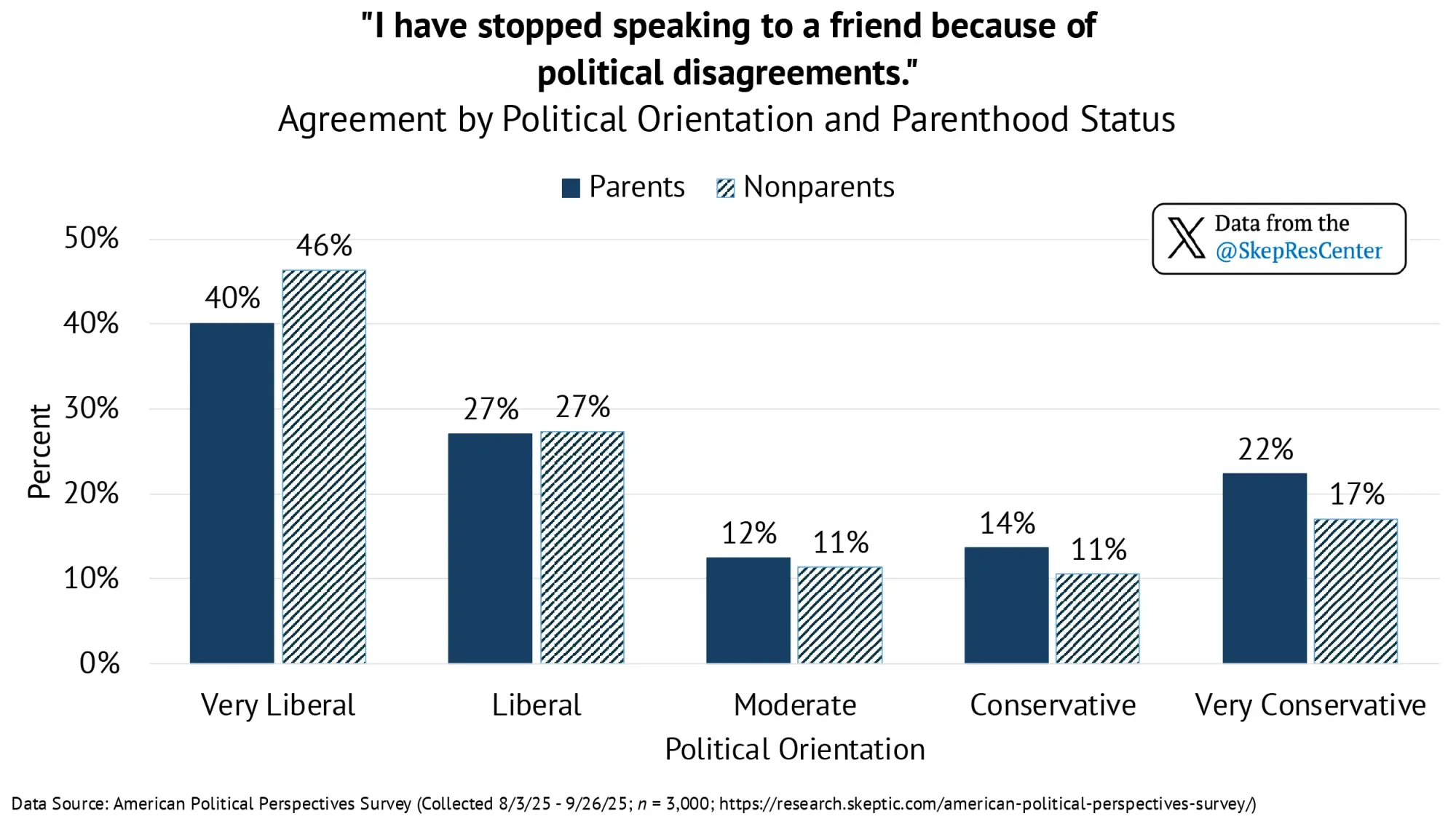
- “Very liberal” nonparents were more likely to say they have severed ties than other groups.
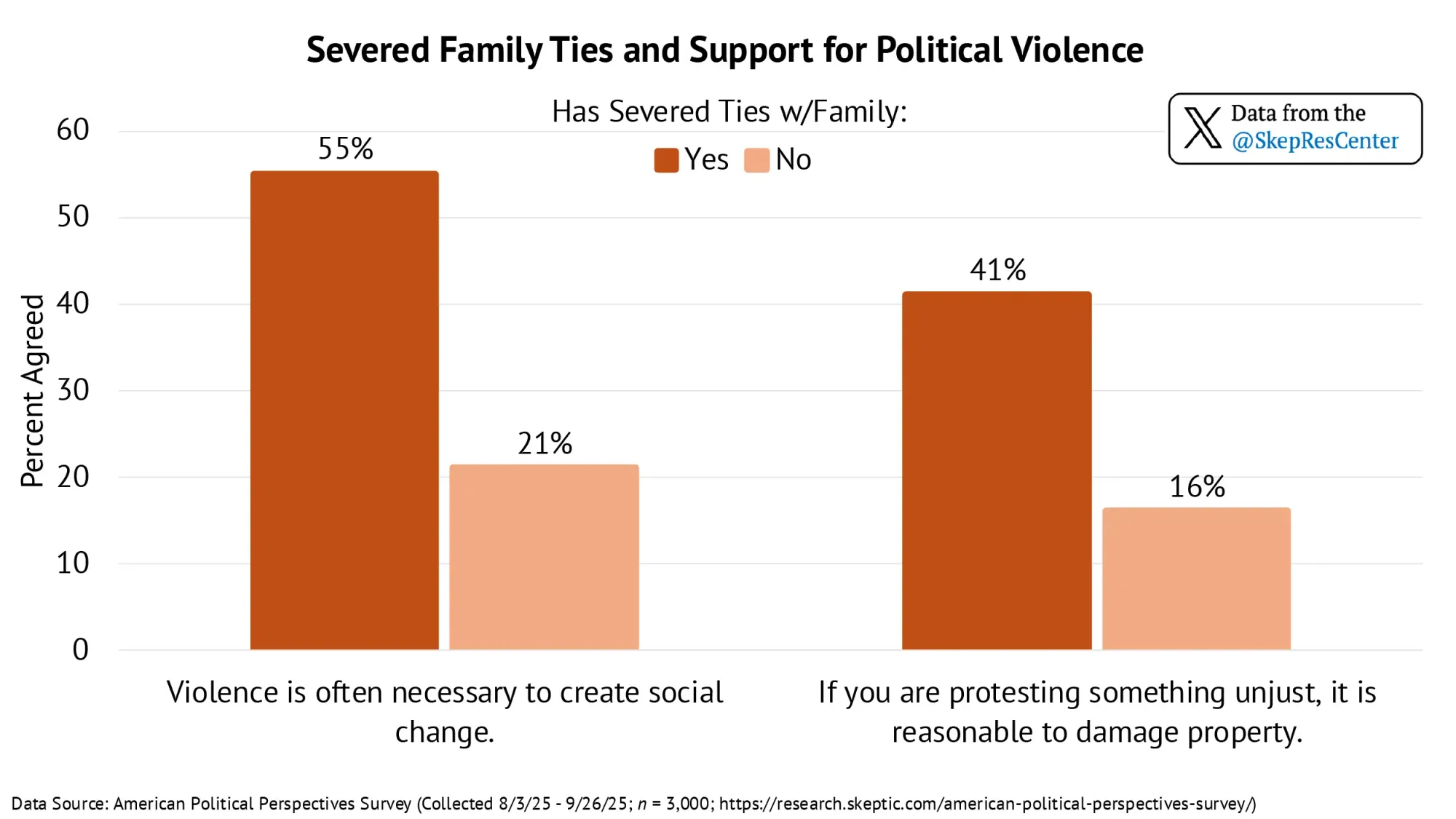
- Those who have severed ties with family were twice as likely to support/find necessary acts of political violence compared to those who have not severed ties.
McCaffree, K., & Saide, A. (2025). Severing Social Ties Over Political Disagreements: An Update With New Data. Skeptic Research Center. Retrieved from https://research.skeptic.com/severing-social-ties-over-political-disagreements-an-update-with-new-data/
Background
Conventional wisdom says we’re more comfortable fighting over politics with people we know, people we’re close to, rather than acquaintances.1 But, even when it comes to friends and family, some people would rather end a relationship before disagreeing politically.
In the politically tumultuous Summer of 2020, PEW reported2 the results of a survey indicating that 80 percent of Americans have “none” or “just a few” friends with political views different from their own. A few years later, the American Psychiatric Association3 found that around 20 percent of Americans had become estranged from family due to political disagreements, with an additional 20 percent skipping family events because of political disagreements. Another recent study found that around 1 in 6 Americans have ended or considered ending a romantic relationship because of a political disagreement.4
This may be a burgeoning trend. Younger Americans appear to be more likely than older ones to sever ties.5 For example, while over half (58 percent) of 13–25-year-old Americans in one recent large survey6 agreed with the statement “it is possible to have a close relationship with someone who doesn’t agree with me on political issues,” 42 percent disagreed or were ambivalent. Some evidence suggests that Americans might even stand out globally as uniquely unwilling to date someone with different politics.7
In September 2024, the Skeptic Research Center conducted a groundbreaking survey of about 3,000 Americans which revealed a troubling landscape of findings. Consistent with prior work, about 20 percent of the sample told us they would end a relationship with a friend or family member over political disagreements. Gen Z and Millennials were the groups most likely to say they would sever ties with friends and family over political disagreements, but political liberals across all age groups were more likely than other political groups to say they would sever ties with friends and family.
Our 2024 survey was truly pathbreaking and, as such, many have asked for a follow-up report using new data. Our new results from our latest survey follow.
Methodology and Data Quality
The data from this report comes from the American Political Perspectives Survey (APPS) collected from August 3, 2025, to September 26, 2025, with three thousand American adults who speak English. All respondents needed to pass (1) four attention checks, (2) a duplication check, (3) time-to-completion checks (i.e., those taking the survey in under 7 minutes were dropped), (4) fraud checks, and (5) bot-identification checks.
Quota sampling was used to approximate a representative sample of the U.S. public regarding sex, race, age, and educational attainment. Quotas were determined using U.S. Census data. Additional attempts were made to oversample Asians. Respondents were recruited using Qualtrics Panel Services.
Further details on the respondents can be downloaded.
To measure willingness to sever ties over political disagreements, respondents were asked whether the following statements were or were not true of them: (1) “I have stopped speaking to a family member because of political disagreements.” (2) “I have stopped speaking to a friend because of political disagreements.” Answer categories were “Yes, this is true of me” and “No, this is not true of me.”
Summary of Findings
A key difference between our latest 2025 survey and the prior 2024 survey was our wording of the question related to severing ties. In 2024, we asked whether survey takers would sever ties with friends and family over politics, but in our latest survey, we asked whether they’d already ended a relationship with friends or family over politics. In this respect, the present results speak not to peoples’ intentions (whether they’d consider ending a relationship) but to peoples’ de facto behavior (whether they’ve, in fact, already ended a relationship over politics).
First, the good news: only 18.6 percent of our total sample told us that they’d “stopped speaking to a friend because of political disagreements,” and an even smaller percentage, 13.9 percent, said they’d stopped speaking to a family member. This tells us that, among Americans overall, the actual severing of ties over politics is atypical.
Nevertheless, that nearly 1 in 5 Americans have cut ties with friends over politics, and nearly 1 in 6 Americans have cut ties with family, is still a discomforting amount of social and personal conflict. Put another way, of the 3,000 Americans we surveyed, 557 had severed ties with friends over politics and 418 had severed ties with family. That is a nontrivial finding.
Age and Generation
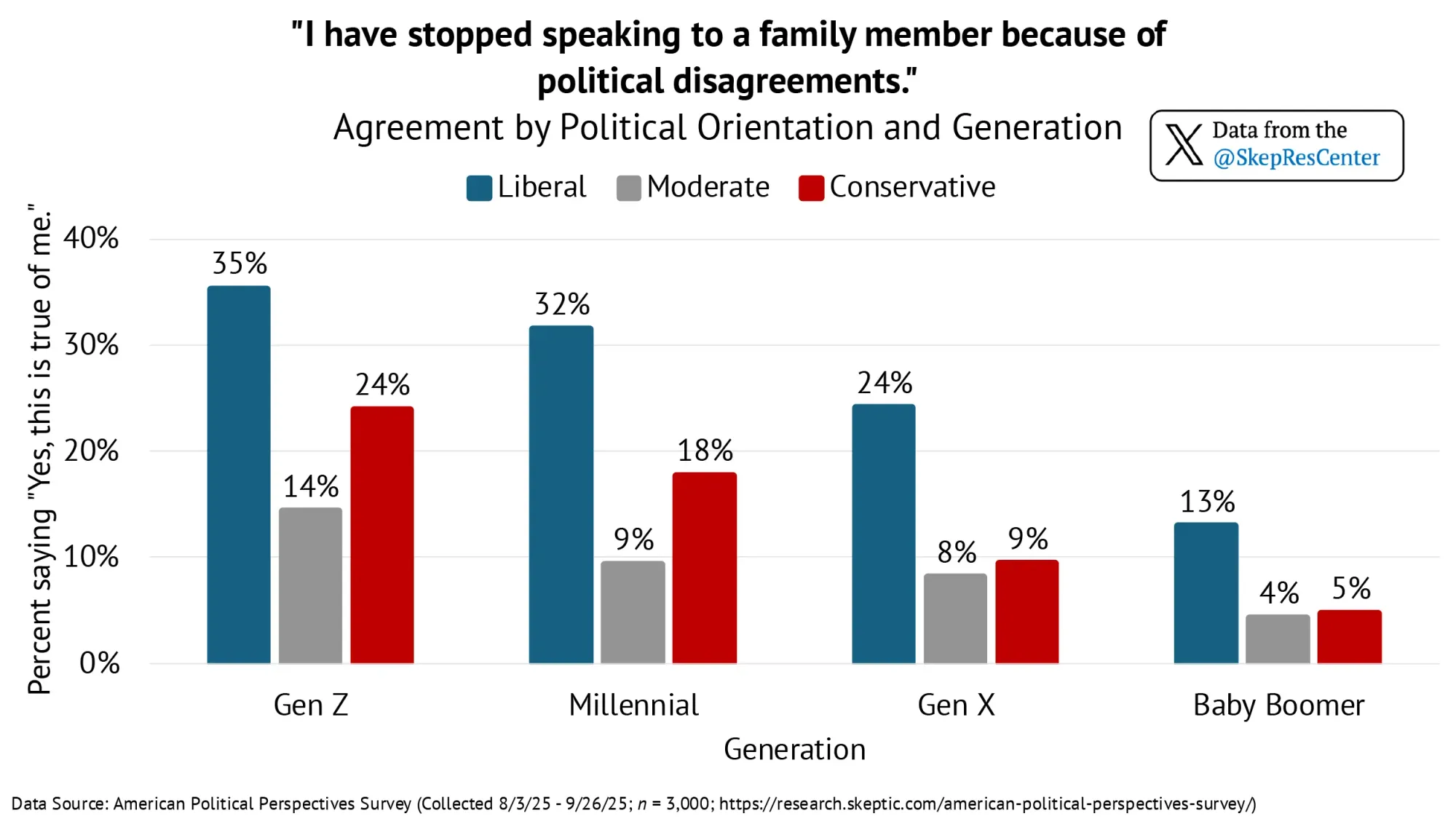
Across age groups, political liberals were substantially, and consistently, more likely to say they’ve “stopped speaking to a family member because of political disagreements.” Specifically, over a third of Gen Z liberals, just under a third of Millennial liberals, and a quarter of Gen X liberals told us they’ve cut ties with family. Even Baby Boomer liberals ended family relationships over politics more often than did Gen X or Millennial moderates. However, while liberals were the group most likely to have cut ties with family over politics, Gen Z and Millennial conservatives were more likely to cut ties than were their moderate counterparts (see Figure 1 below). Political moderates, in general, were consistently less likely than partisans to cut ties with family over politics.
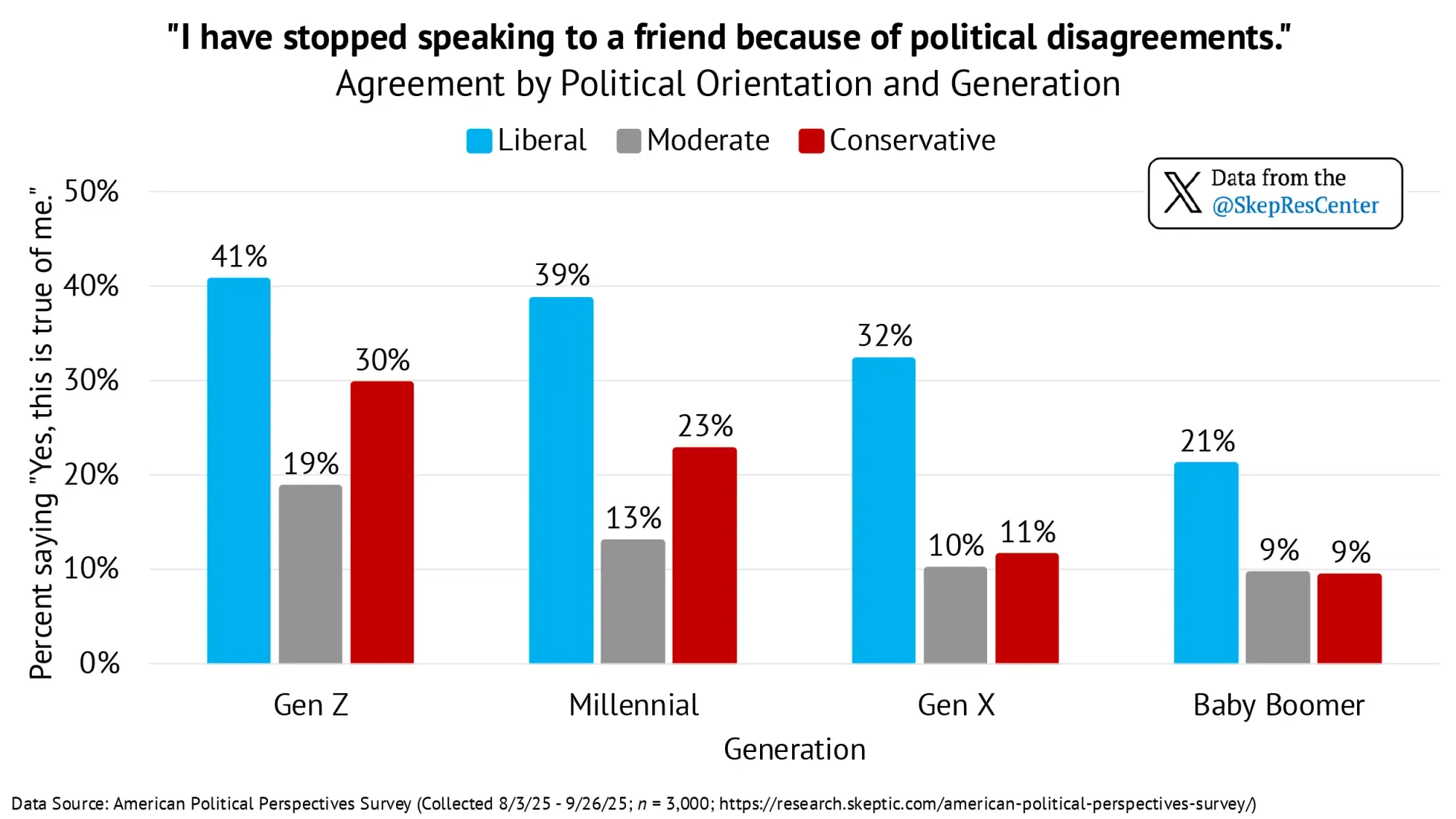
We found similar results regarding peoples’ tendency to sever ties with friends over politics. Over 40 percent of Gen Z liberals, nearly 40 percent of Millennial liberals, nearly a third of Gen X liberals, and just over 1 in 5 Baby Boomer liberals told us they’ve cut ties with a friend over politics. As above, younger generations, not just liberals, were more likely to cut ties with friends—nearly 1 in 5 Gen Z moderates in our sample cut ties with friends (see Figure 2 below).
A Closer Look at Politics
Next, we considered more precisely the relationship between political orientation and the tendency to sever ties over politics. To do so, we disaggregated survey respondents who identified as “very liberal” and “very conservative” to examine how more extreme partisans responded.
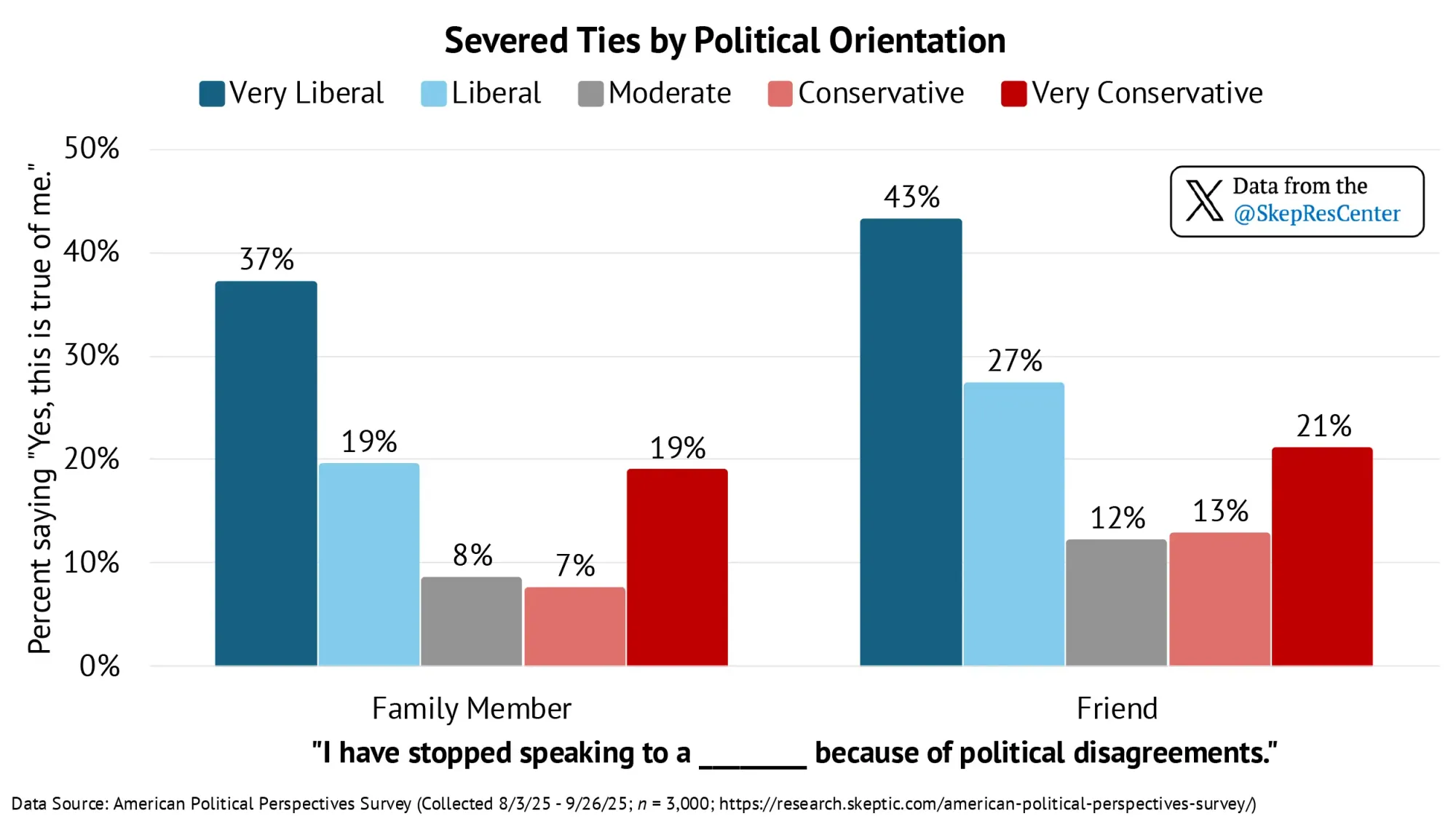
We found that, overall, about 40 percent of the “very liberals” in our sample have ended relationships with family or friends, and that this is a higher rate than any other political group. It also wasn’t just those identifying as “very liberal,” but also those identifying more casually as “liberal,” who cut ties at elevated rates.
Once again, then, we find political liberals, regardless of the strength of their ideological commitment, are more often severing ties with friends and family over politics. In addition to this, however, we were able to discern an interesting U-shaped pattern in the data, with “very liberal” and “very conservative” respondents severing relationships at higher rates than their “liberal” and “conservative” counterparts. This supports the commonsense intuition that the stronger someone’s political views, the more likely they are to break off relationships over politics (see Figure 3 below).
The Impact of Parenthood
In our 2024 survey, we found an interesting difference between parents and nonparents, with parents less likely to say they’d be willing to sever ties with friends and family over politics. But, again, in 2024 we measured only willingness to sever ties and not whether people had severed a tie with friends and family. So, what are the new data telling us?
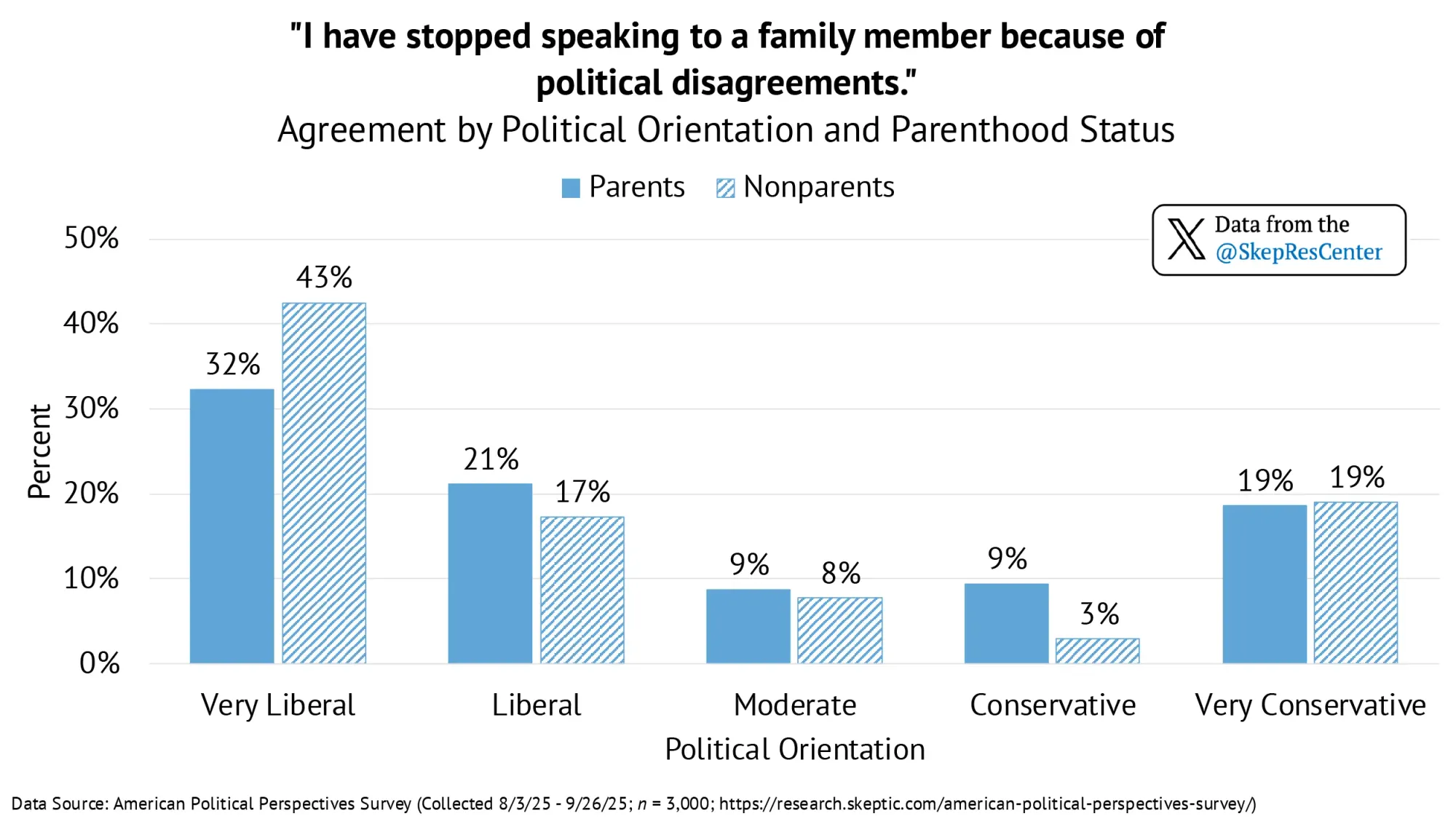
Regarding the propensity to sever ties with family, three fascinating findings emerged (see Figure 4 below). First, results revealed that, among “very liberals,” nonparents broke off ties with family at a rate of 43 percent, 11 percentage points higher than “very liberals” who were parents. This suggests that not being a parent is one driver of the difference in propensity to sever ties between “very liberals” and everyone else. Interestingly, though, among “liberals,” parents were very slightly more likely to sever ties than were nonparents.
Second, and just as interesting, politically “conservative” parents were three times more likely to say they’d cut ties with family than were “conservative” nonparents. Thus, the relationship we see for “very liberals” (nonparents sever ties at higher rates than do parents) reverses when it comes to “conservatives” (parents sever ties at higher rates than do nonparents). To our knowledge, this is the first time this dynamic has been brought to light in social science research.
Third, for political “moderates” and “very conservatives,” being a parent (or not) made little to no difference with regard to the propensity to break off relationships with family over politics. Taken together, why parenthood should be associated with lower rates of family dissolution for liberals, higher rates of family dissolution for conservatives and be unrelated to family dissolution for liberals, moderates and “very” conservatives are all intriguing questions. We invite readers to write us with suggestions that we could test in future research.
We found similar patterns regarding peoples’ severing of friendship ties (see Figure 5 below). “Very liberal” nonparents severed ties with friends more often than did “very liberal” parents. And, liberal and moderate parents did not differ much from nonparents in their tendency to sever ties. When it came to “conservative” and “very conservative” respondents, though, we found parents had severed ties with friends more often than nonparents.
Support for Political Violence
In most cases, family is our primary source of social support. Friends come and go, as they say, but family relationships are generally more stable over time. Might there be serious, even radicalizing, consequences for those who sever familial relationships over politics?
To assess this, we examined two of our measures of support for political violence:
- “If you are protesting something unjust, it is reasonable to damage property” (answer categories ranged from “strongly agree” to “strongly disagree”).
- “Violence is often necessary to create social change” (answer categories ranged from “strongly agree” to “strongly disagree”).
What we found was striking (see Figure 6 below)—over half (55 percent) of those who’d severed ties with a family member over politics believed that violence was often necessary for social change, compared to 21 percent of those who have not broken off family relationships over politics. The same basic relationship existed for property crime: 41 percent of those who’d severed ties with a family member over politics believed that property damage is acceptable if you feel morally justified, compared to 16 percent of those who have not cut ties over politics.
Unfortunately, we cannot speak to causality with our correlational data. This means we cannot say for sure if severing ties with family makes one more supportive of political violence, or if those already supportive of political violence are more likely to sever ties. As in most such cases in social science, there is probably a feedback loop where both dynamics are operating. Regardless, the strong connection between support for political violence and having cut ties with family is disturbing and requires follow-up research.
Concluding Thoughts
Last year, the Skeptic Research Center conducted a survey of the American public revealing, among other things, that younger and more liberal Americas were more willing to sever ties over political disagreements; this 2025 survey demonstrates something more serious than a willingness to sever ties—it shows that people are severing ties at fairly high rates.
Our 2024 survey also revealed some interesting trends regarding the extent to which Americans were most willing to sever ties over politics. First, we had found no sex differences—men in 2024 were as willing to sever ties over politics as were women. In this 2025 survey, however, when it came to reporting whether ties had already been severed, men were more likely to report severing ties; however, the differences between men and women were so small (e.g., 16 percent of men vs. 12 percent of women severing ties with a family member) that we don’t want to overinterpret these results.
Our 2024 survey did reveal, for the first time in the scientific literature, that nonparents (i.e., adults with no children) were more willing to sever ties than were parents. At the time, we speculated that this might be due to parents’ greater investment in family and friendship networks; raising a child is difficult, thus, parents may place greater value on having and maintaining support networks.
In this 2025 survey, which measured whether people had in fact severed a tie, we couldn’t find a consistent pattern of cutting ties based on parenthood status. For example, while “very liberal” nonparents were more likely than “very liberal” parents to say they have cut ties, the reverse was true among “conservatives” and among “liberals.” In other words, our 2024 survey indicated that parents were never more willing than nonparents to sever ties with family members, but this 2025 survey suggests that, in practice, parents may indeed sever ties over politics as much as, if not more than, nonparents.
