By Kevin McCaffree & Anondah Saide
To celebrate six years of bringing data to discussions about controversial issues, let’s walk through a compilation of 20 of the most interesting findings.
We’ve learned a lot about people’s attitudes, accuracy, and degree of misinformation. We have covered a wide range of topics; no topic is off limits to scientific inquiry. The surveys were designed to measure topics across the political spectrum and, as you’ll see below, the results have been insightful.
1. People overestimate the number of unarmed Black men killed by police.
Shortly after the BLM and George Floyd 2020 Summer unrest, we asked people to estimate how many unarmed Black men were killed by police in 2019. We found that though everyone overestimated the correct number, liberals overestimated to a much larger extent. For example, 53 percent of “very liberal” Americans, compared to 20 percent of “very conservative” Americans, guessed 1,000 or more (the actual number was 11).
We also found that the more someone trusted news media, the more they overestimated the percentage of Black people shot by police. For example, people with the highest levels of trust in news media guessed that around 57 percent of people shot by police are Black while the actual percentage is around 25 percent.
2. Americans underestimate the damage done during the summer 2020 George Floyd and BLM unrest.
Most Americans are unaware that the George Floyd and BLM riots were the most destructive in American history, leading insurance agencies to designate them as a “catastrophe event.”
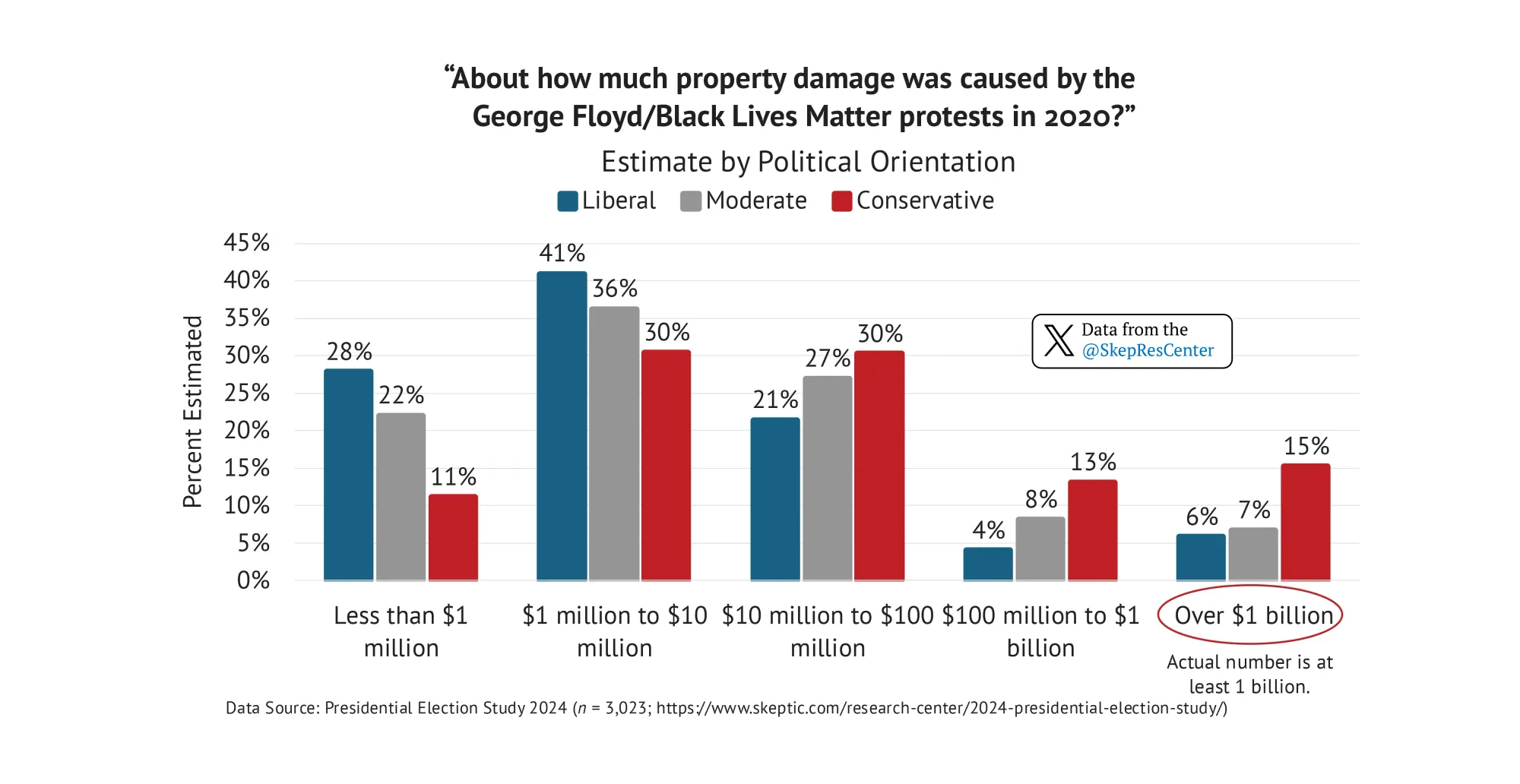
4 in 10 liberals and 3 in 10 conservatives estimated that the protests and riots caused between “$1 million to $10 million” in damage when the actual figure is over $1 billion (see graph below). Additionally, we found that people with higher trust in journalists were more likely to underestimate the amount of damage caused by the Floyd/BLM protests/riots.
3. Conservatives and liberals show different patterns of inaccuracy on crime.
When it comes to violent crime in general, conservatives were much more likely to believe, falsely, that in 2024 violence was at historic high. While 49 percent of very liberal Americans believed “violent crime is at the highest levels in our country’s history,” 84 percent of very conservative Americans thought that was true. However, when we looked at a specific politically charged case of violence, school shootings, conservatives tended to be more accurate. While over half of conservatives guessed, correctly, that ~50 people die in school shootings, only around one third of liberals answered similarly.
4. People overestimate identification with “Latinx.”
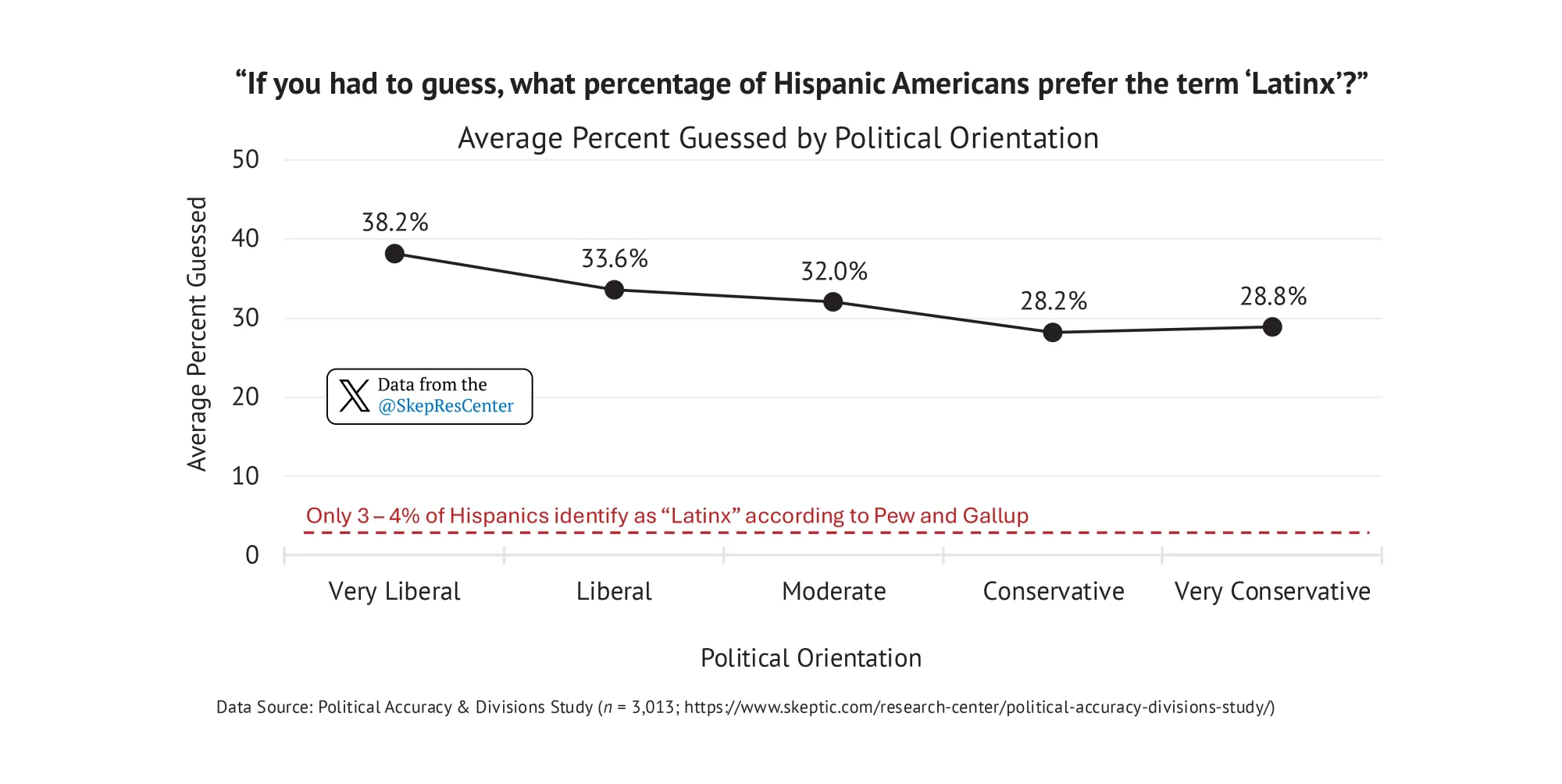
In a survey we conducted in 2022, we found that regardless of political orientation, people vastly overestimated the percentage of Hispanic Americans that identify with the term “Latinx.” While most Americans guessed around 30 percent, in fact, only 3 to 4 percent of Hispanics identify as “Latinx” (see graph below).
5. Young people identify with mental health challenges at much higher rates.
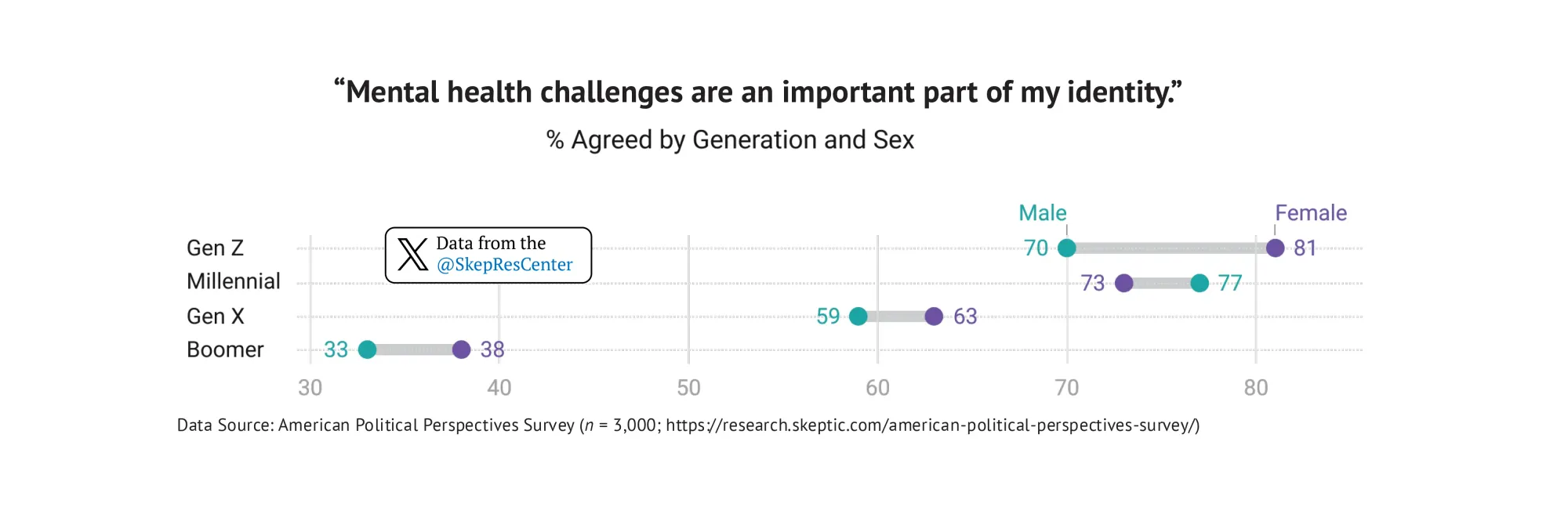
In a 2025 survey, we found that younger adults identify with mental health challenges at significantly higher rates than older adults (see graph below). For example, while 38 percent of female Baby Boomers identified with mental illness, 81 percent of female Gen Z did. Also, over 1 in 3 Americans identify with mental illness, even with no, or minimal, depression or anxiety.
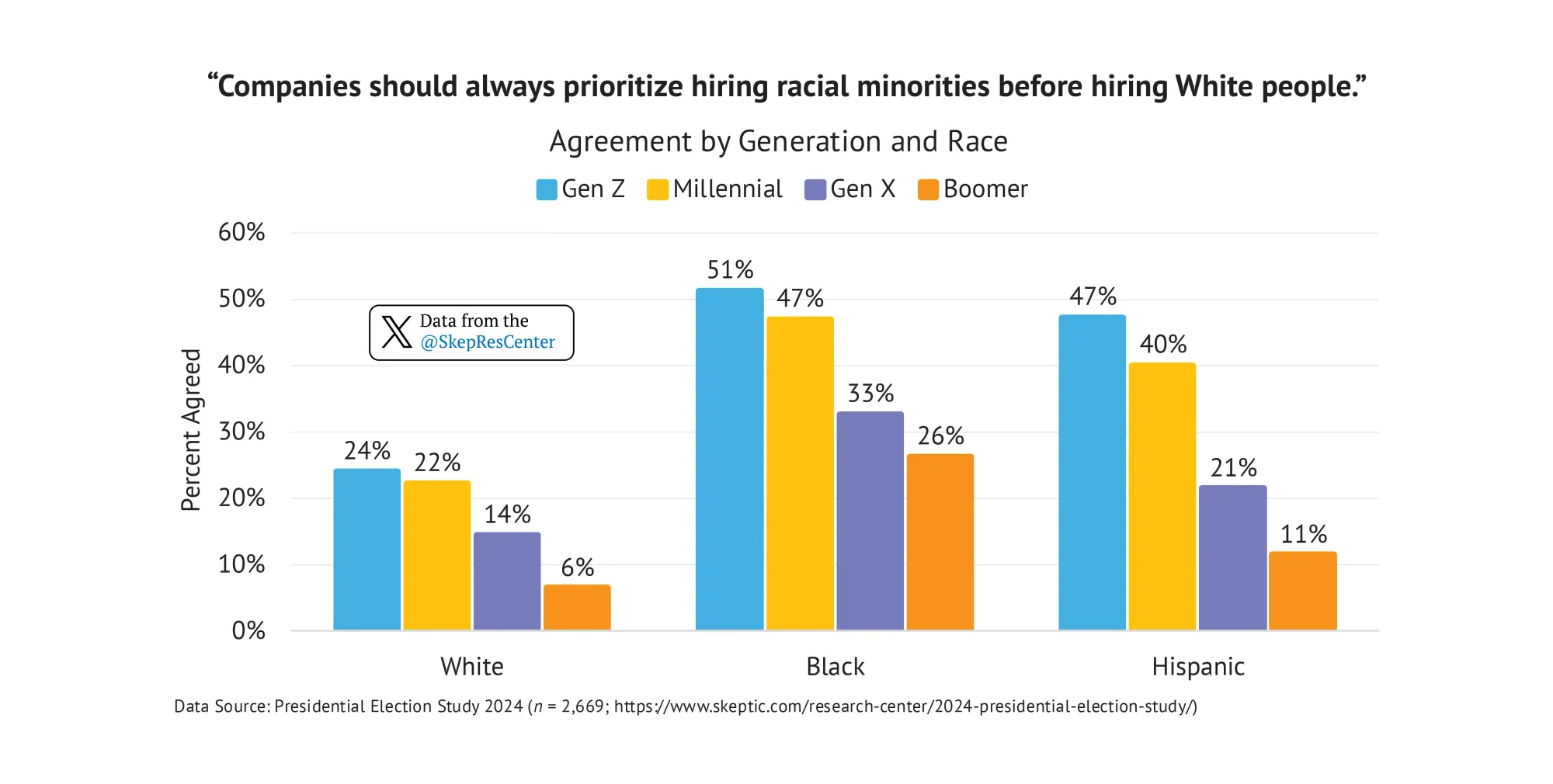
6. Young racial minorities support discriminating against White people in hiring.
In the fall of 2024, we found that nearly half of Black and Hispanic Gen Z’ers support discrimination against White people in hiring decisions (see graph below). Further, we found that greater trust in news journalists was associated with greater support of racial discrimination against White people—this pattern held regardless of political orientation. For example, when trust in journalists is high, 32 percent of liberals and 28 percent of conservatives agree with racial discrimination, but when trust is low, 22 percent of liberals and only 7 percent of conservatives agree.
7. Most people believe in the “noble savage” myth.
In a survey conducted in 2022, around 7 in 10 adults identifying as “very liberal” agreed that Native Americans lived in peace and harmony prior to European colonization (nearly half of “very conservative” Americans agreed).
In the 2024 presidential election survey, nearly 1 in 3 “very liberals” believed that European colonization is the reason why there isn’t world peace (around 1 in 5 of conservatives believe that as well).
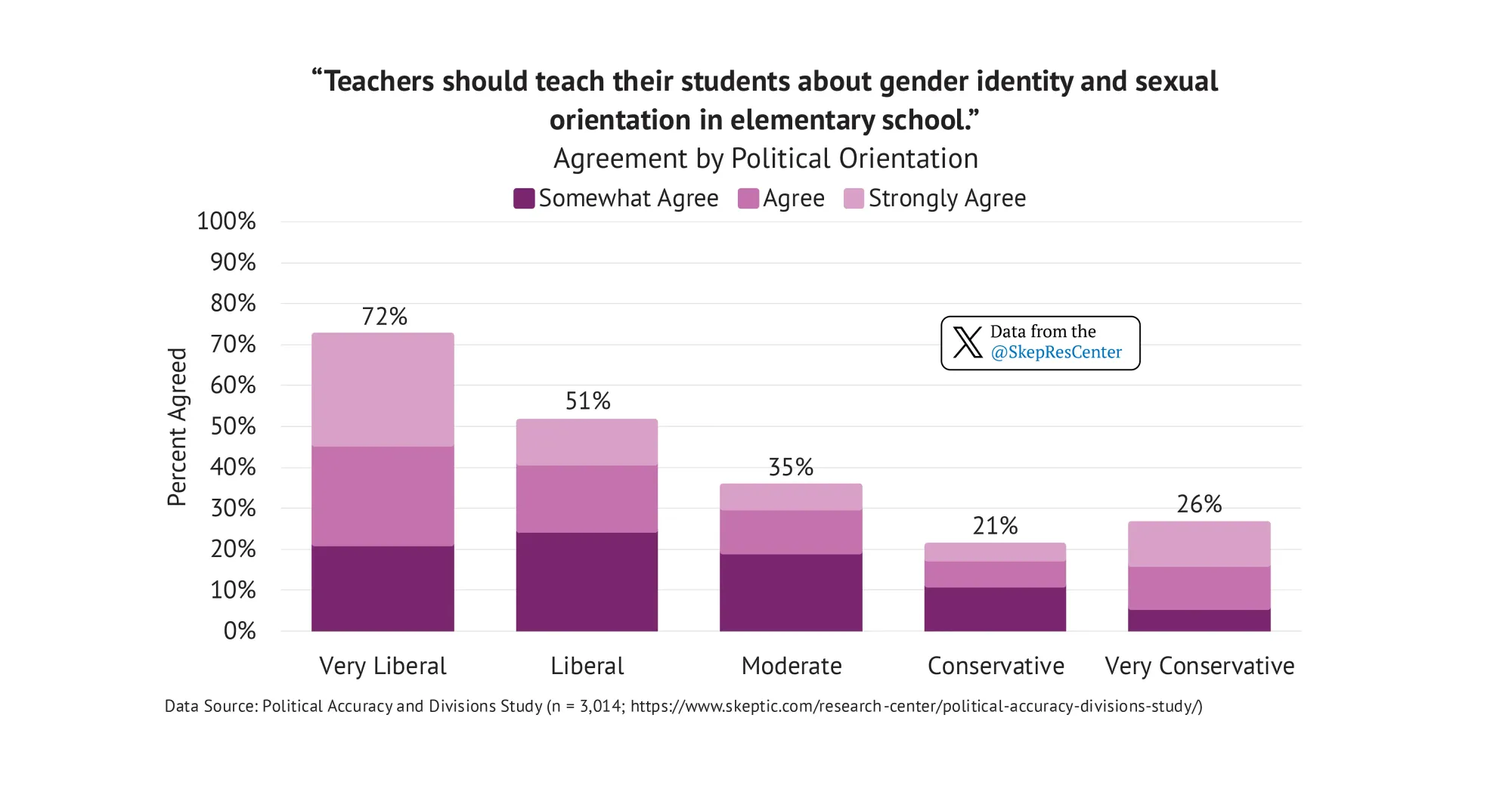
8. Gender identity policies lack majority support outside of the political left.
Across two surveys, we found that transgender-related policies are not generally popular. Only those who identify as “very liberal” express majority support for allowing biological males to compete in women’s sports, or express support for teachers sharing information on gender identity and sexual orientation in elementary school (see graph below). No group expresses majority support for giving children puberty blockers and/or hormones; however, liberal women without children are the most likely to support doing so.
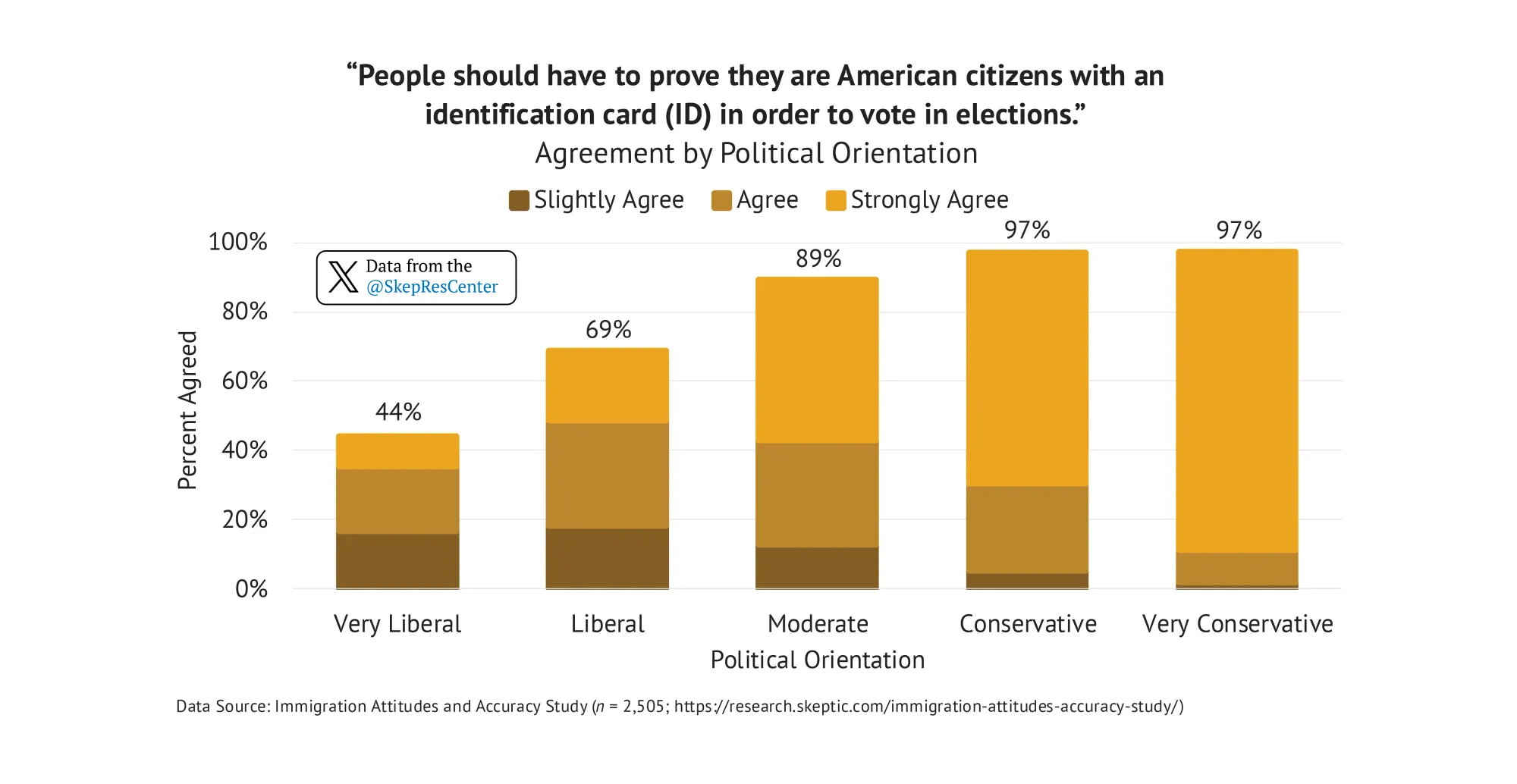
9. The majority of adults support voter ID.
Across two surveys, we found that the majority of Americans believe people should have to prove they are citizens via an ID card to vote (see graph below). Liberals, however, were more likely than moderates or conservatives to believe requiring an ID card to vote is also a racist practice. For example, while 5 percent of conservative Baby Boomers believed the practice is racist, 47 percent of liberal Baby Boomers believed it is.
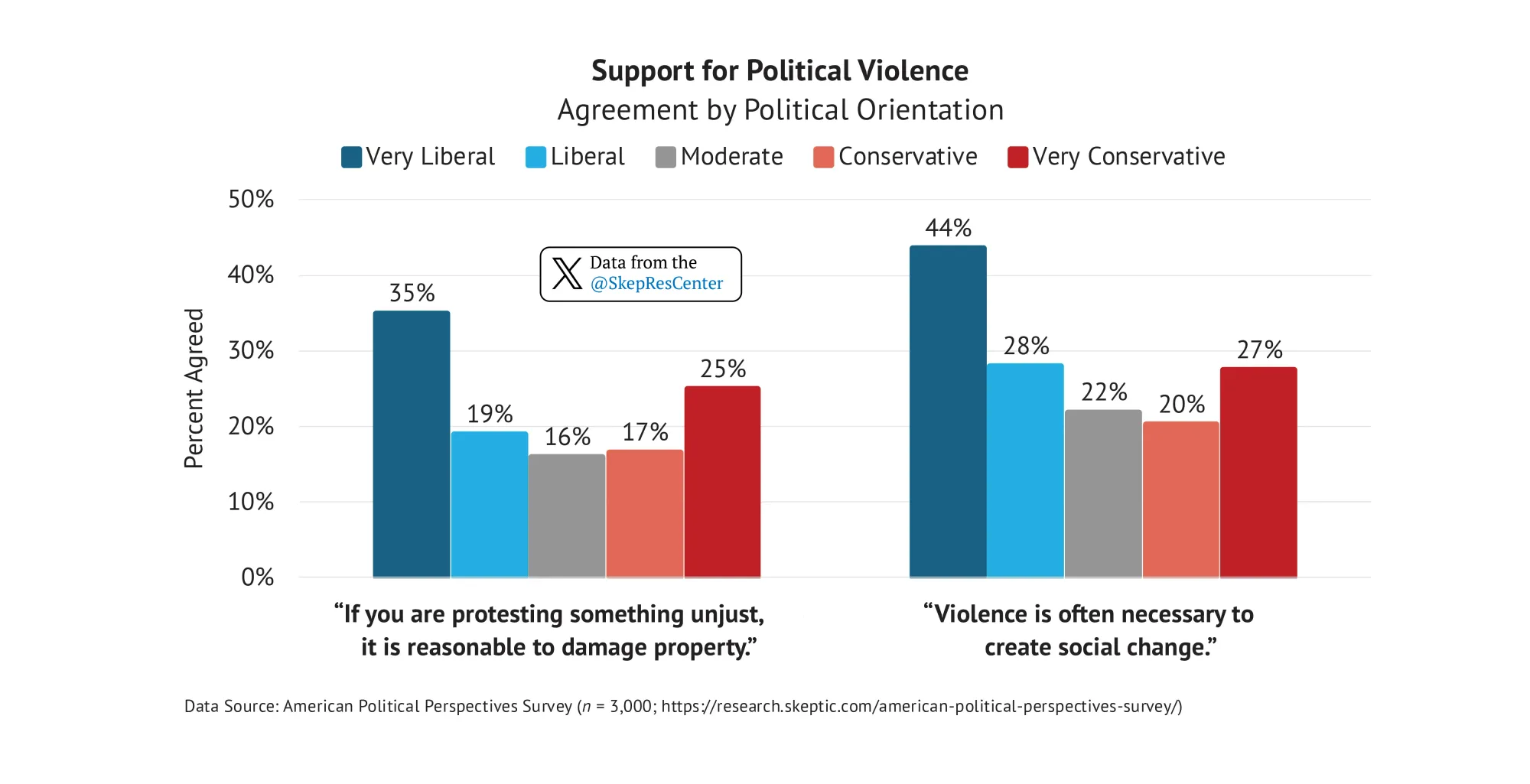
10. Support for politically motivated violence is higher among younger adults, racial minorities, and political liberals.
In a 2025 survey, we found that, while most people do not support politically motivated violence, those most likely to agree with it were younger, Black, highly educated, and “very liberal” Americans. For example, while 35 percent of “very liberal” Americans agreed that it is reasonable to damage property when protesting “something unjust,” 25 percent of “very conservatives agreed (see graph below).
11. Women are more in favor of censorship and more likely to falsely believe the government has hate speech laws.
In multiple surveys we found that women were more in favor of censorship. In 2020, female Americans were more inclined to want to prevent people from believing, saying, and doing what they want.
With respect to online political discourse specifically, we found that older women were particularly favorable to censorship. For example, 49 percent of female Baby Boomers (versus 37 percent of male Baby Boomers) didn’t think people should be allowed to share inappropriate political views online. Women, in general, were also more likely than men to believe, incorrectly, that the United States government has laws against “hate speech.”
12. Young liberals more often end relationships over politics.
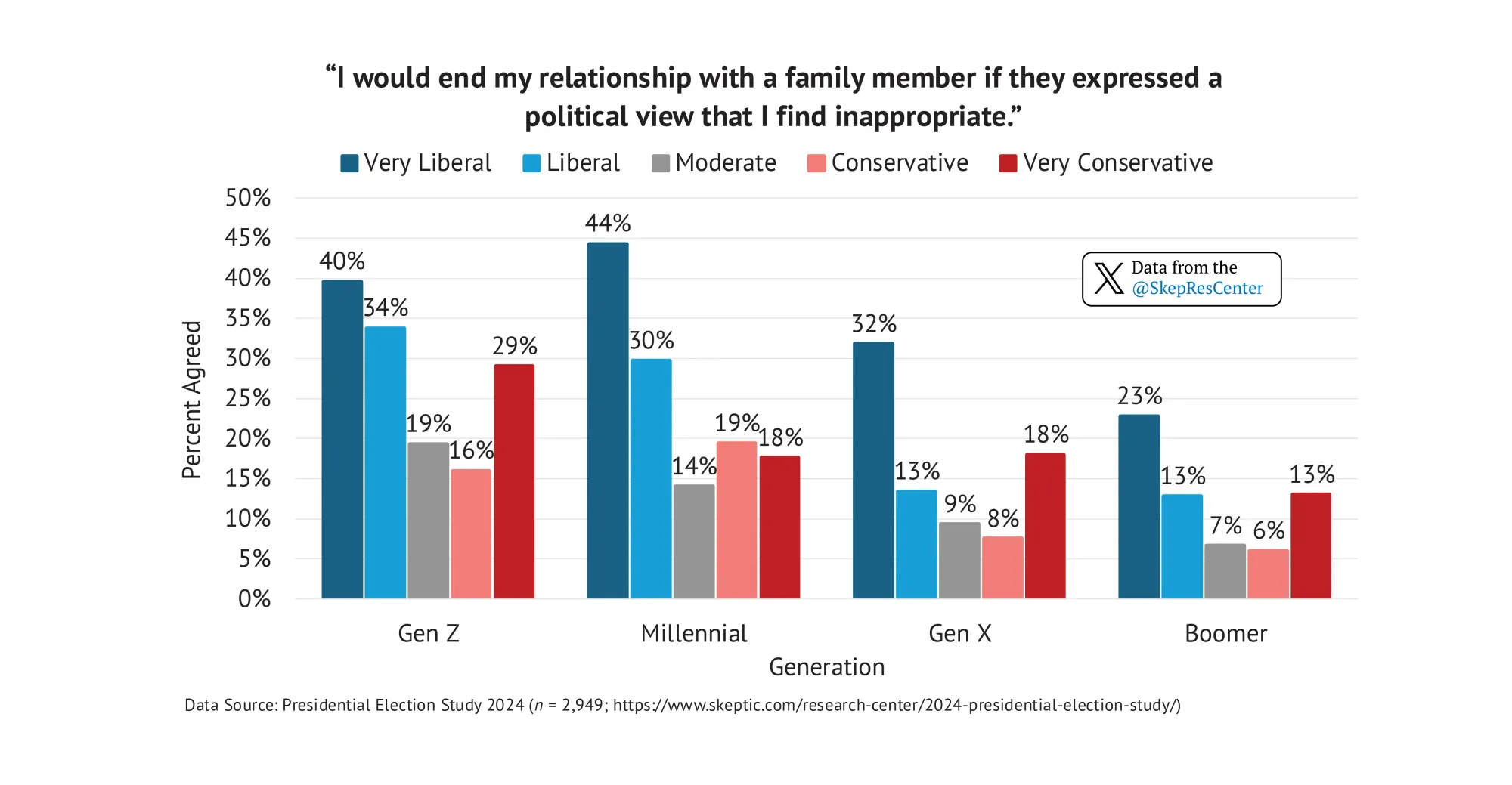
In a 2024 survey, we found that over a third of young liberals would end a relationship with a family member over political disagreements (see graph below). In a 2025 survey, more than a third of them said they had already done so. Those that identified as “very liberal” (regardless of age) were twice as likely as those that identified as “very conservative” to say that they have already ended a friendship and stopped speaking to a family member over politics.
13. People underestimate illegal immigration and accuracy is associated with policy support.
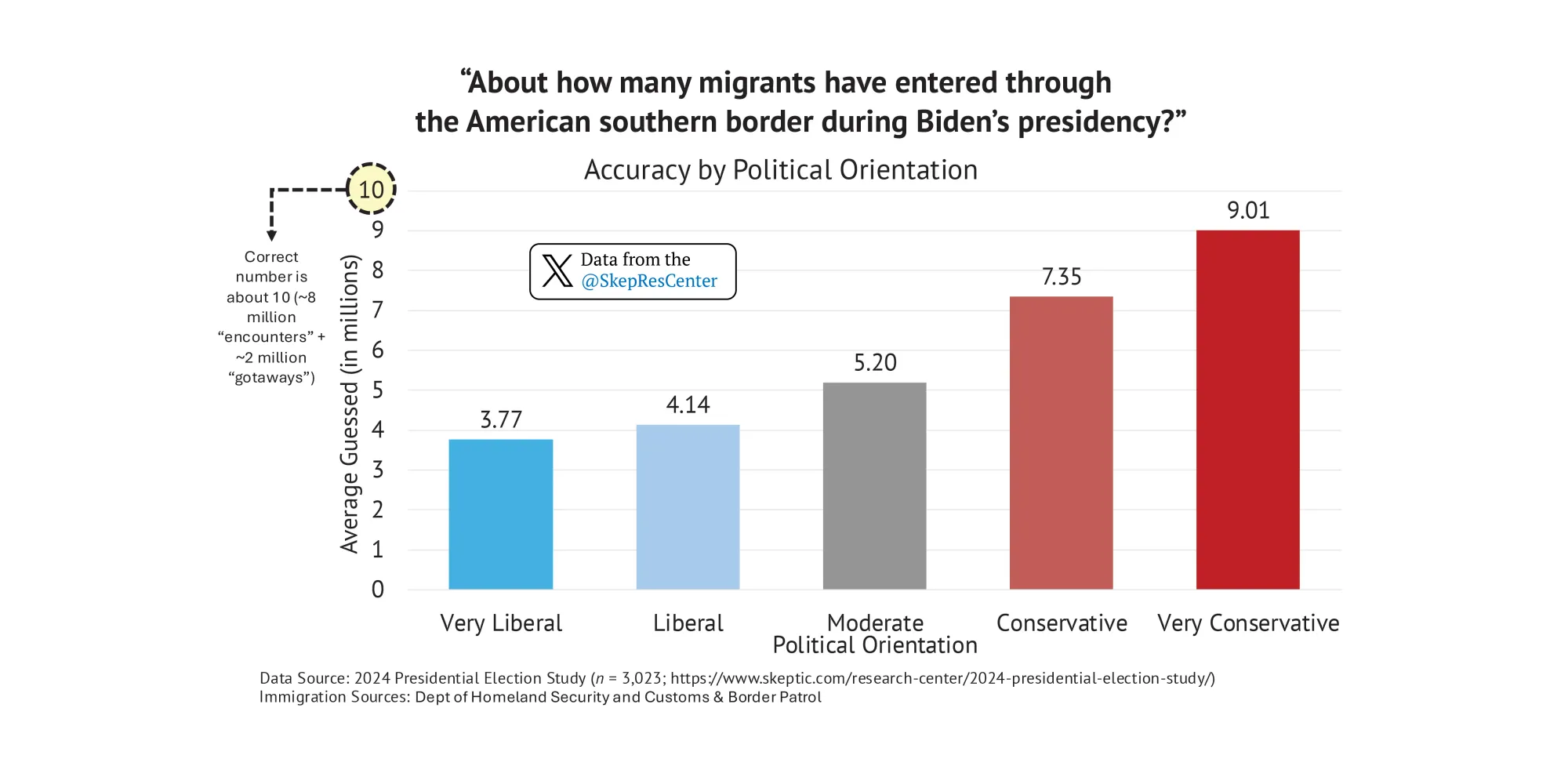
Most Americans underestimated the number of illegal immigrants that came into the country during Biden’s Presidency (at least 10 million entered illegally, see graph below). Liberals were the least accurate group guessing approximately 3.7 million. Liberals were also much more likely to believe that the United States government has a moral obligation to provide health care to illegal immigrants.
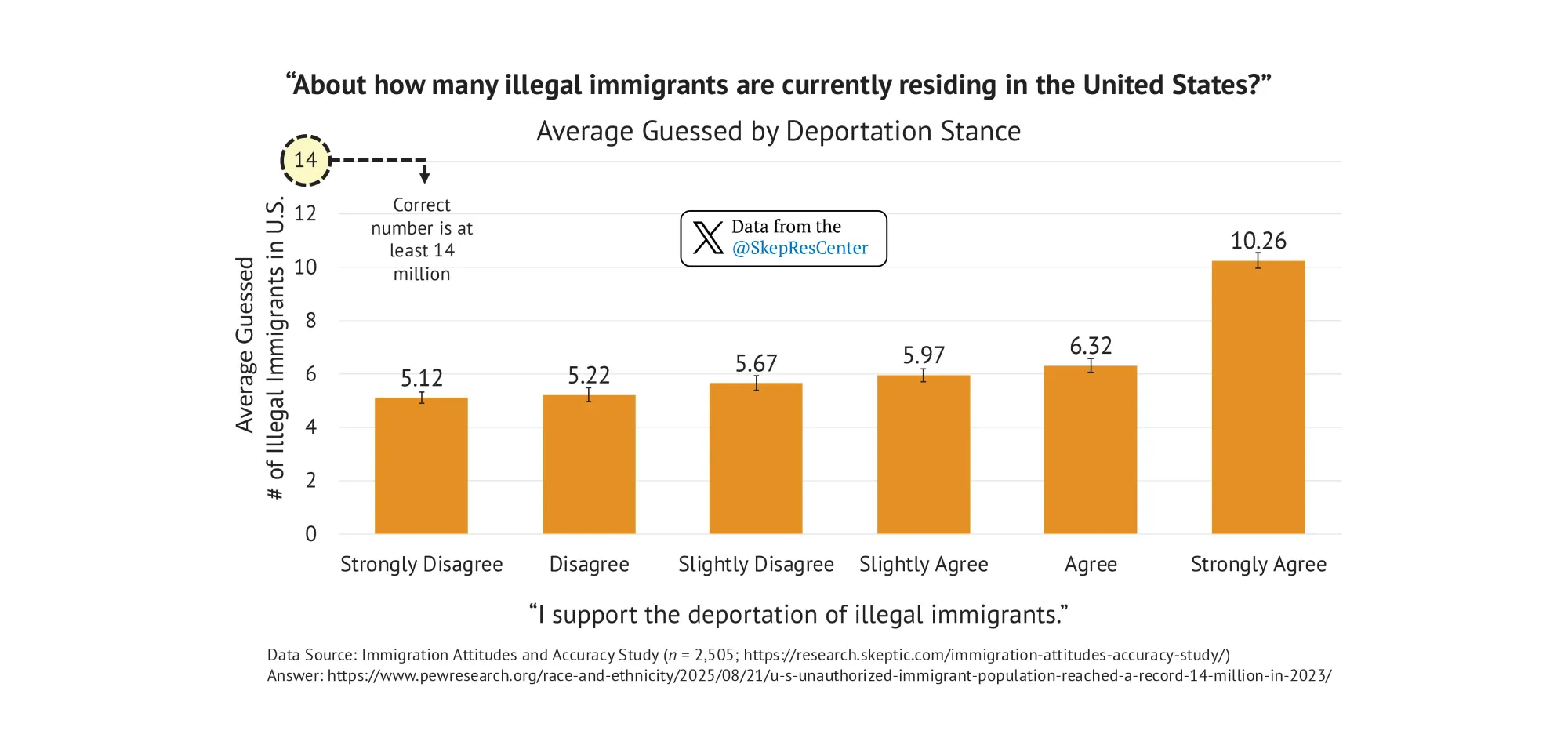
In a follow-up survey, we found that the Americans who most strongly supported the deportation of illegal immigrants also most closely guessed the number of illegal immigrants currently in the country (see graph below).
14. Immigration enforcement is the great divider.
The most extreme differences we have found between “very liberal” and “very conservative” respondents have been related to immigration enforcement: 3 percent of “very liberal” Americans trust Immigration and Customs Enforcement (ICE) to act in the best interests of the public compared to 90 percent of people that identify as “very conservative.”
There is also a significant divide between support for deportation in general vs. support for how the Trump Administration has handled deportations. For example, while 2 in 3 moderates support deportations in general, only 1 in 3 moderates support “the way Donald Trump has handled enforcing immigration policy.”
15. Far-left political ideology is associated with more severe depression.
Individuals that identify as “very liberal” are more than twice as likely (compared to “very conservatives”) to agree that racial minorities and women cannot be successful because of racism and sexism. They are also twice as likely to agree that White people should be discriminated against in hiring decisions. Notably, greater endorsement of these ideas has been associated with higher depression scores, particularly for White people and men.
16. Young adults and racial minorities are more likely to endorse popular conspiracy theories.
A common finding in the academic literature is that younger people express greater conspiratorial ideation. We have found further support for this: Gen Z and Millennial adults were the most likely to endorse a variety of conspiracy theories (e.g., 9/11 was an inside job, the 2016 election of Donald Trump was fraudulent, the 1969 moon landing was faked by NASA). Black Americans were the most likely, and White Americans the least likely, to endorse demographic conspiracies (e.g., conspiracies related to race and sex).
17. Younger adults express greater anti-Israel sentiment.
Approximately 44 percent of Gen Z adults agreed that the Israeli government advocates for White supremacy, and more than one third of Gen Z adults believed that Hamas had a moral obligation to commit the October 7th attack that resulted in the killing of ~700 Israeli civilians and the abduction of ~250 hostages.
18. Conservatives show mixed accuracy on abortion facts.
Conservatives were more likely to believe (incorrectly) that the number of abortions have increased or stayed the same since the 1980s (in fact, abortions have decreased in prevalence). Conservatives also substantially over-estimated the percentage of women who oppose abortion access—9 percent of women in the United States want full abortion restrictions, but conservatives guessed the number to be 55 percent. However, conservatives were less likely to believe (incorrectly) that, by overturning Roe v. Wade, the Supreme Court banned abortion.
19. Greater trust in journalists is associated with believing misinformation about Trump.
Relative to individuals that report having low trust in journalists, those with high trust were approximately 1.5 times more likely to believe (falsely) that Trump has not condemned white supremacy (69 percent vs. 47 percent). Relative to individuals that report having low trust in journalists, those with high trust were approximately 1.8 times more likely to believe (falsely) that Trump told his supporters to use violence to take over the U.S. Capitol on January 6, 2021 (67 percent vs. 36 percent).
20. Highly educated Americans are often misinformed on controversial race and sex issues.
Americans with the highest levels of formal education hold several important false beliefs about race issues in America. Nearly a third of Americans with graduate degrees believe White people invented slavery, 3 in 4 believe White people are the richest group in America, and over half are unaware that qualified Asian applicants are regularly rejected from colleges and universities. 1 in 3 of the most highly educated Americans are also cynical about the ability of racial minorities and women to be successful.
CODA: Aren’t you just targeting liberals?
This critique is not common, but we do hear it from time to time. No, we’re not targeting liberals, but we are targeting topics that are often considered taboo by left-leaning mainstream academics, journalists, and other cultural elites. If it looks as if liberals are more often inaccurate, this is likely not because of conservatives’ greater intelligence or insight, but because of liberals’ closer proximity to systematically biased, but influential, mainstream institutions (e.g., media, education).
Our goal is to ask questions that are currently unasked and probe fallacies where people presume authority and expertise. It is a healthy angle for any group of nonpartisan researchers to take.
Two more points. First, take a look at finding #3 and #18—we do find that conservatives are more inaccurate on overall crime rate increases and also more often misinformed on abortion-related topics. Second, we are genuinely eager to study forms of misinformation and support for extreme attitudes on both sides of the political spectrum. If you have an idea for areas where conservatives (or liberals) are likely to be misinformed—share it with us by emailing [email protected].
